


There are moments in markets when two signals begin flashing at the same time, and investors instinctively know the combination is uncomfortable.
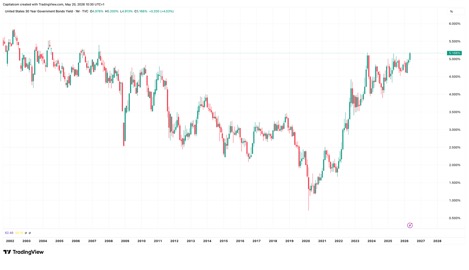
One of those moments is now. US equities remain near record highs while long-dated Treasury yields are climbing to levels not seen since before the Global Financial Crisis. The yield on the 30-year Treasury has pushed above 5%, territory last visited in 2007, and yet the Nasdaq and S&P 500 continue to behave as though financial conditions are not tightening at all. That divergence is becoming increasingly difficult to ignore.
Traditionally, yields rising to these levels would force a repricing in equities. Higher yields increase discount rates, tighten financial conditions and make future earnings less valuable in present terms. Historically, markets have struggled to sustain elevated valuations in environments where borrowing costs rise sharply. And unlike previous inflation scares in the post-COVID period, this one is being reinforced by a genuine supply-side shock through energy markets, with the conflict in the Middle East pushing oil prices back above $100 and keeping inflation expectations elevated. What makes the current environment unusual is that equities appear willing to absorb all of this because the earnings backdrop remains extraordinarily strong. The US market, particularly large-cap technology, is being powered by a level of profitability and margin expansion that investors believe can offset the drag from higher yields. The artificial intelligence boom has become the market’s central narrative, and for now it is strong enough to overpower concerns that would typically pressure valuations lower.
That is the key distinction between today and previous late-cycle periods. In 2007, investors were also reassured by strong earnings and healthy-looking balance sheets, particularly in the banking sector. But underneath that optimism sat a financial system increasingly strained by tighter credit conditions. Today, the stress point is different. It is not housing or leverage at the core of the market narrative, it is whether the extraordinary spending cycle around AI infrastructure can continue long enough to justify current valuations. The concentration of market leadership tells the story. The rally has become heavily dependent on a relatively small group of mega-cap technology companies, particularly those tied to semiconductors, hyperscaler spending and AI infrastructure.
In effect, markets are treating the AI revolution as a force strong enough to partially neutralise tighter financial conditions. But there is a risk that this creates a dangerous asymmetry. Bond markets are signalling that inflation may remain structurally higher than previously assumed. Oil prices, government borrowing needs and persistent services inflation are all pushing yields upward. At the same time, valuations in US equities remain historically elevated. The cyclically adjusted price-to-earnings ratio is now approaching levels previously associated only with the dot-com era. In other words, markets are trading with “2000-style” equity optimism alongside “2007-style” bond market stress.
US 30-year bond yield (2002 – 2026)
Past performance is not a reliable indicator of future results.
The post Equities are ignoring the bond market appeared first on USNewsRank.