
Chinese People’s Liberation Army (PLA) honour guards hold Chinese and U.S. flags, before the welcome ceremony for U.S. President Donald Trump by Chinese President Xi Jinping at the Great Hall of the People in Beijing, Thursday, May 14, 2026. (Maxim Shemetov/Pool Photo via AP)
LOS ANGELES — Filipinos continue to view the United States more favorably than China, bucking a broader global shift toward more positive views of Beijing, according to Pew Research Center surveys released July 15.
The findings are drawn from parallel Pew surveys conducted from Feb. 8 to May 13, 2026. One surveyed 42,151 adults across 36 countries to compare global views of the US and China, while the other surveyed 45,658 adults across 37 countries – including the United States – to examine how China’s image is evolving worldwide.
76% of Filipinos view China as biggest threat
Across the 36 countries surveyed, China received more favorable ratings than the United States in 25 countries, reflecting an improvement in Beijing’s global image since the COVID-19 pandemic alongside declining views of the US in many parts of the world.
The United States remained more popular than China in only six countries – the Philippines, India, Israel, Japan, Poland and South Korea – while views were closely divided in the remaining countries.

FILE PHOTO
The survey’s most notable finding for the Philippines concerned national security. Asked in an open-ended question to identify the country posing the greatest threat to their nation, 76 percent of Filipinos named China – the highest share recorded among all countries surveyed. Japan ranked second at 53 percent, followed by Australia at 52 percent.
You may like: FBI seizes 13 websites it says were used by China to recruit US workers
Tensions in West Philippine Sea
The findings come amid long-running tensions in the West Philippine Sea, the area of the South China Sea where the Philippines and China have overlapping maritime claims. China claims sovereignty over much of the South China Sea through its “nine-dash line,” which overlaps with the Philippines’ 200-nautical-mile Exclusive Economic Zone (EEZ).
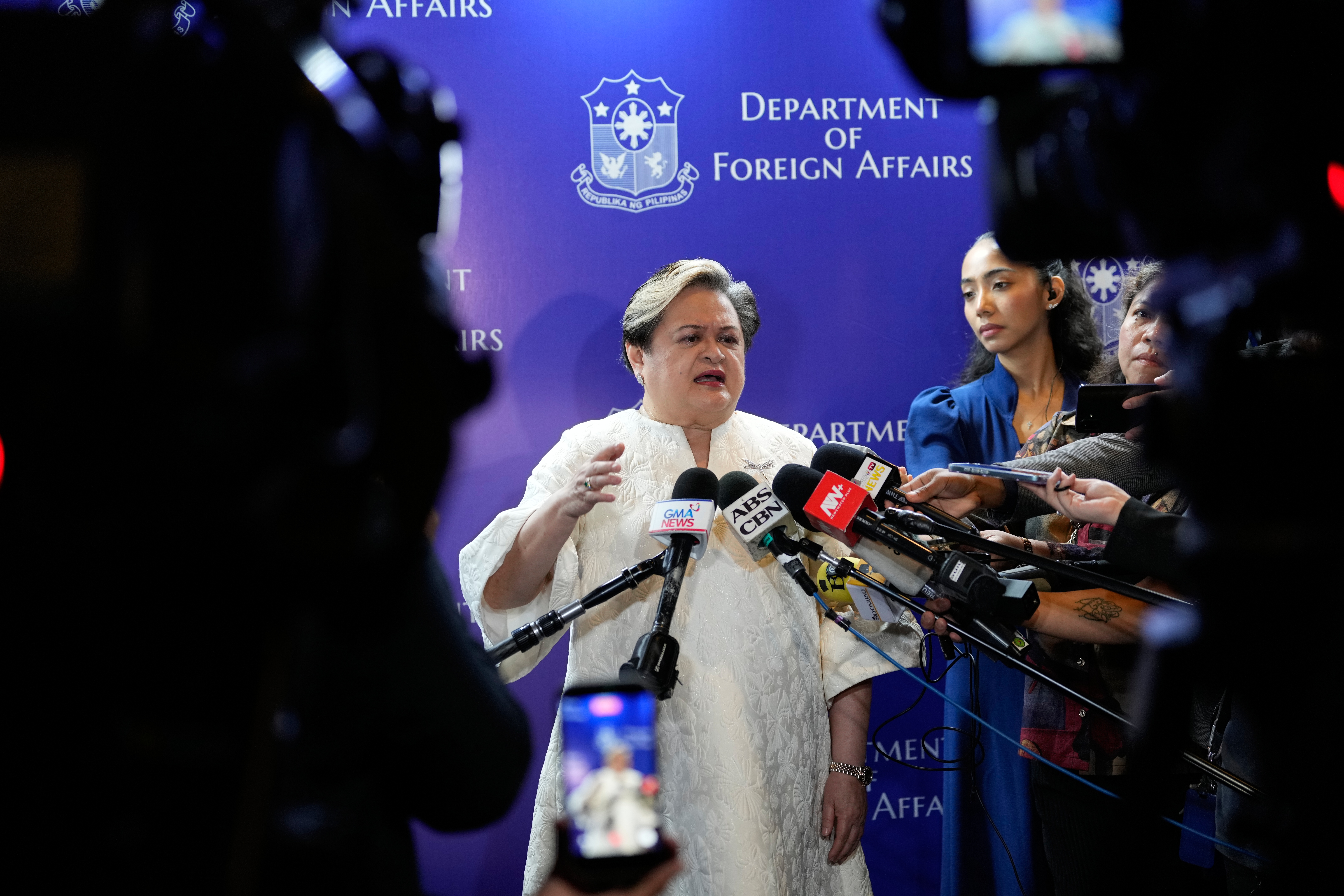
Philippine Foreign Secretary Maria Theresa Lazaro answers questions from reporters as they mark the 10th anniversary of a 2016 arbitration ruling which invalidated China’s expansive claims in the disputed South China Sea during a conference in Manila, Philippines on Friday, July 10, 2026. (AP Photo/Aaron Favila)
Manila maintains that its maritime rights and resource claims are based on the United Nations Convention on the Law of the Sea (UNCLOS) and brought a case against China before the Permanent Court of Arbitration in 2013.
You may like: PH marks 10 years of South China Sea ruling: ‘Right is might’
In 2016, an international tribunal ruled in favor of the Philippines, finding that China’s historic rights claims within the nine-dash line had no legal basis under UNCLOS, a decision Beijing rejected as “null and void.”
Territorial disputes
The dispute has focused on contested areas, including Second Thomas Shoal (Ayungin Shoal), where the Philippines maintains the BRP Sierra Madre as an outpost and where Philippine officials have reported repeated Chinese Coast Guard attempts to block resupply missions; Scarborough Shoal (Bajo de Masinloc), which China has controlled since a 2012 standoff; and Sabina Shoal (Escoda Shoal), an area linked to Philippine resupply operations.
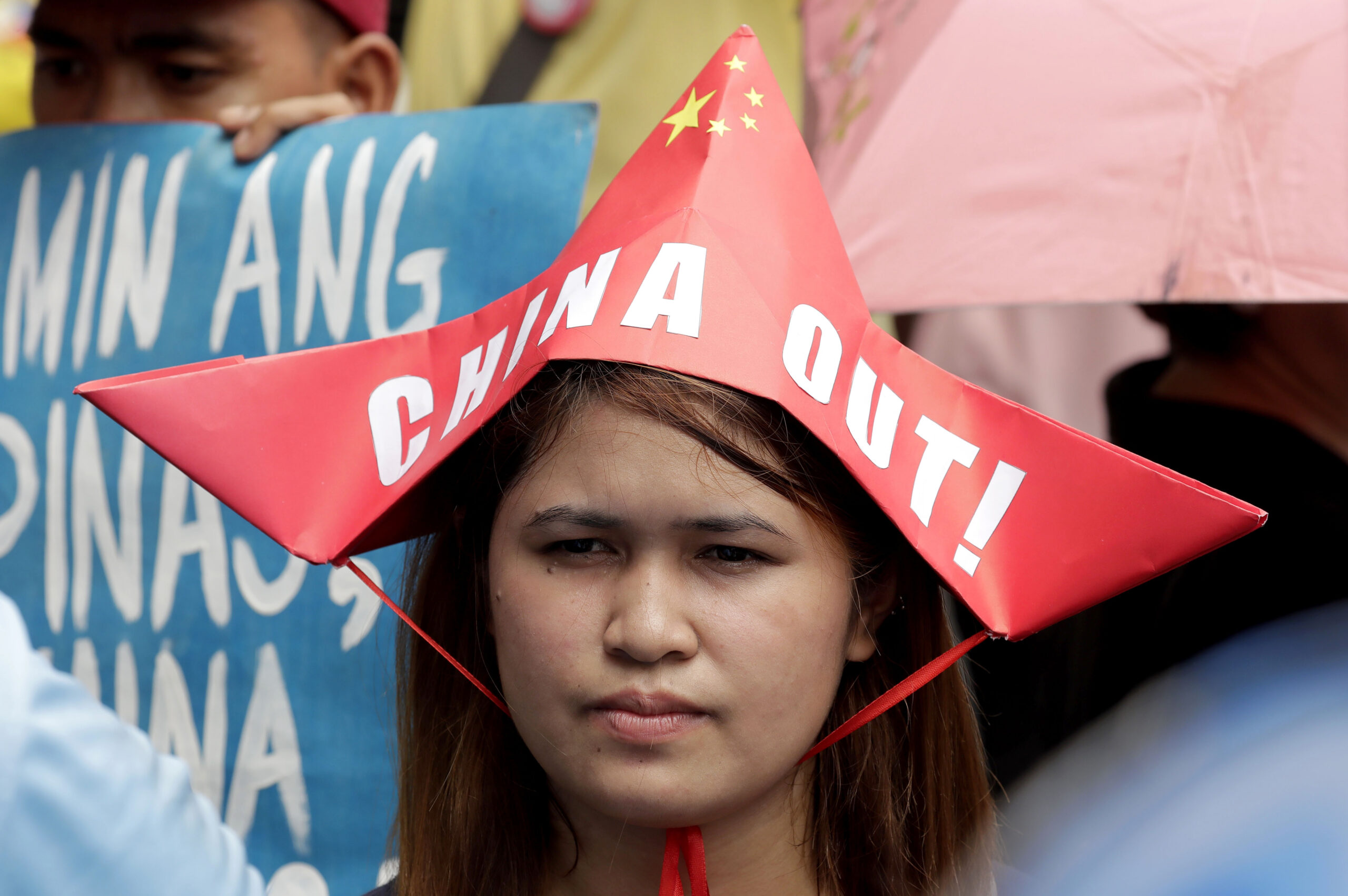
A protester wears a boat-shaped hat as she joins a rally at the Chinese Consulate to commemorate the 3rd anniversary of the Arbitral Ruling in The Hague by the UNCLOS (United Nations Convention on the Law of the Sea) granting the Philippines the exclusive right to fish within its Exclusive Economic Zone or EEZ Friday, July 12, 2019 in the financial district of Makati city, east of Manila, Philippines. (AP Photo/Bullit Marquez)
In response to what Manila describes as increasing Chinese assertiveness, the Philippines has pursued a transparency strategy to document incidents and strengthened defense ties and joint patrols with partners including the United States and Japan.
The Pew survey showed that Filipinos, along with Japanese and South Korean respondents, also remained among the most concerned about territorial disputes involving China and its neighbors.
Pew said those concerns have stayed consistently high in the Philippines, Japan and South Korea since it began tracking the issue in 2014.
Trump vs Xi
That wariness also extended to views of national leaders. While more respondents expressed confidence in Chinese President Xi Jinping than in US. President Donald Trump in 22 countries worldwide, the Philippines was among a handful of Asian countries — alongside India and Japan — where Trump received higher confidence ratings than Xi.
Filipinos also stood apart from most of their Asia-Pacific neighbors on the question of trust. Only 42 percent described China as a reliable partner, compared with at least seven in 10 respondents in most other Asia-Pacific countries surveyed.
That finding came from a separate Pew survey of 17 middle-income countries, which found that respondents generally viewed the US as more likely than China to interfere in other countries’ affairs, while more often describing China as a reliable partner and a contributor to global stability.
Beijing’s global image improves
Globally, a median of 51 percent of respondents across the 37 countries surveyed for Pew’s broader report expressed favorable views of China, compared with 39 percent who held unfavorable views. Favorability was strongest in Latin America, sub-Saharan Africa, and parts of South and Southeast Asia, while it remained weaker in wealthier countries across Europe, North America and East Asia. China’s favorability reached or neared historic highs in Italy, Spain, Indonesia, Malaysia, Mexico, Nigeria and Singapore, the researchers said.
Concerns about China persist elsewhere. Only 11 of the 37 countries surveyed had about half or more of respondents saying Beijing respects its people’s personal freedoms. Pew noted, however, that US ratings on the same measure have declined since 2021, narrowing what had long been a wide gap between the two countries.
The findings leave the Philippines among the few countries where the United States maintains a clear advantage over China in public opinion, despite Beijing’s improving global image.
Source: Pew Research Center – “People in Many Countries Now View China More Positively Than the U.S.,” “Views of China and Xi Are Improving Globally” and “China’s Image in the Asia-Pacific Region” (July 15, 2026).
The post Filipinos still favor US over China as Beijing’s global image improves – Pew poll appeared first on USNewsRank.