


Scott Bradshaw, Investment Manager, Mattioli Woods
It’s the summer of 1966. England is hosting the FIFA World Cup. Sir Alf Ramsey’s squad take to the pitch at Wembley for the final against West Germany, and they do something unexpected: they win: 4-2, after extra time, with Geoff Hurst completing the first hat trick ever scored in a World Cup final. England haven’t won since.
The detail that tends to get lost in the nostalgia: Ramsey’s winning squad was not built around superstars. He famously dropped England’s traditional wingers in favour of a system built on balance and structure, with every player knowing their precise role. Banks in goal, Moore at the back, Charlton driving from midfield and Hurst the finisher. No single point of failure, and no one position carrying the team. This translates to one of the most important lessons in investing.
The golden generation problem
Fast forward to the 2000s. England assembled what many considered their finest generation in decades: Beckham, Gerrard, Lampard, Scholes, Ferdinand, Rooney. On paper, extraordinary. In practice, serial underachievement, knocked out at the quarter-final stage in 2002, 2006, and beyond.
The diagnosis kept returning to the same flaw: too many world-class players competing for the same positions. Gerrard and Lampard, two of the best midfielders of their era, famously couldn’t coexist in the same system. Brilliance in certain areas, imbalance across others. A portfolio of stars, not a functioning team.
Investors make precisely this mistake. Seduced by recent performance, they pile into whichever market topped last year’s table and find themselves dangerously exposed when conditions shift. The financial equivalent of fielding eleven strikers and hoping for the best.
The league table that never stays the same
The chart below plots annual world stock market returns from 2019 to 2025, ranked best to worst. Each year, the markets jostle for position, and each year, the order changes.
The S&P 500 dominated in 2023 (19.2%) and 2024 (27.3%) – the star player. Yet in 2022, that same market fell 7.8%, finishing near the bottom half of the table. The FTSE All-Share, our home market, fittingly, rarely tops the rankings, yet in 2022 it was the best performer of the year, returning 0.3% while almost everything else fell. The squad player who steps up precisely when the star turns his ankle.
One entry sits quietly in the middle every year: the portfolio, a blended, diversified allocation. It never leads the rankings or wins the golden boot. But over ten years, it has delivered an annualised return of 11.2%, without the volatility of going all-in on any single market. Always there at the final whistle.
Naming your starting eleven
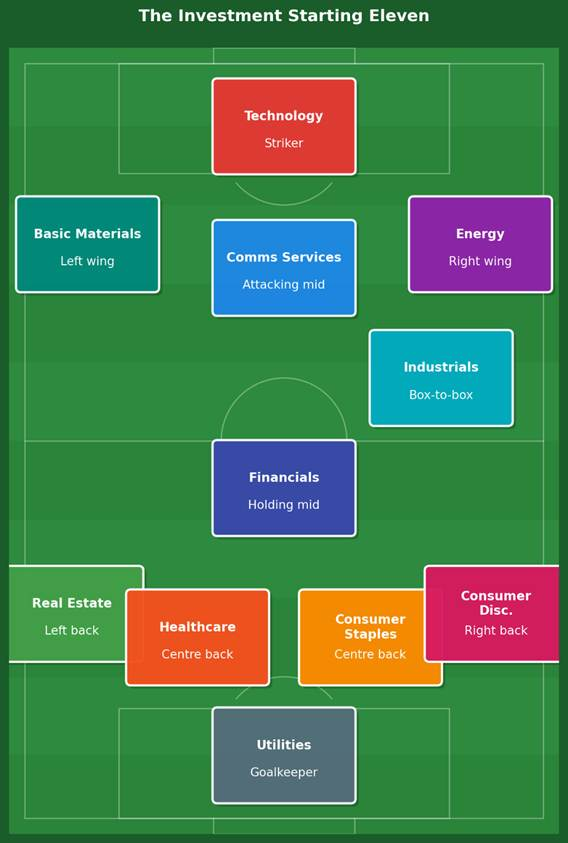
If equity sectors were football positions, the team sheet might read something like this.
· In goal: utilities. The last line of defense, with regulated returns, steady cash flows and no interest in heroics. You won’t notice them in a good year but you‘ll be glad they’re there in a bad one.
· At centre back: consumer staples and healthcare. The dependable pairing at the heart of defense. Mature businesses including Nestle, Unilever, and AstraZeneca, built to absorb pressure when markets turn volatile. Healthcare can also contribute going forward, with pockets of growth in biotechnology when conditions allow.
· At full back: real estate and financials. Solid defensively, with the license to push forward when conditions are right. Real estate offers quiet, income-driven diversification. Financials contribute strongly during economic growth, with banks pushing forward while insurance holds the line.
· In midfield: industrials and communication services. The engine room. Industrials are broad and versatile, spanning aerospace, transport, and construction. Communication services connects and facilitates, with household names including Alphabet, Meta, and Netflix making the whole system function.
· On the wings: energy and basic materials. Electric in the right conditions, quieter when the game slows. Tied to commodity cycles, and not the foundation you build your system around, but a team without them is missing something.
· Up front: technology. The goal-getter. A decade of market leadership, and now the engine of artificial intelligence. The one everyone wants on the team sheet but even the best striker needs the team behind them.
The point is not that any one position is better than another. You need all of them, in the right balance, working as a system.
Building a squad for the long game
At Mattioli Woods, our approach to portfolio construction is shaped by exactly this logic. Our Centralised Investment Proposition is built in layers, much like a well-organized squad.
At the foundation are multi-asset funds and models, drawing on managers including our own Mattioli Woods funds and IBOSS models, as well as solutions from T. Rowe Price, J.P. Morgan and BlackRock, blending active and passive strategies across a wide range of risk profiles. The players who cover every blade of grass, in every condition.
Above that sit single-strategy allocations across UK direct equity, responsible investing, cash solutions, and property income – specialist positions, deployed when conditions call for them.
At the top, for those with the appropriate appetite, sits our specialist offering: bespoke solutions, enterprise investment schemes, venture capital trusts, and private markets through Maven. High potential, carefully deployed, and only effective when the rest of the squad is already functioning well.
No single layer wins tournaments on its own. Together, they give a portfolio the best possible chance of performing across different conditions, the good years and the difficult ones alike.
The best-organized team wins
England has spent nearly sixty years waiting to repeat 1966. The golden generation came and went. Tournaments have been won and lost on individual errors and the kind of bad luck that no amount of talent prevents.
Investing is not so different. Markets surprise and last year’s winner rarely repeats. What Sir Alf Ramsey understood, and what the data continues to confirm, is that the teams and portfolios built to last are not the ones with the most stars. They’re the ones built with balance, depth, and a clear plan for every position on the pitch.
In both the beautiful game and long-term investing, it’s rarely the most glamorous team that lifts the trophy. It is the best-organized one.
The post Pick your squad, not your stars: what the world cup teaches us about investing appeared first on USNewsRank.