


“The only thing that helps me pass the time away
Is knowing I’ll be back at Echo Beach someday”
10-yrs ago we voted for a Brexit built on lies, hopes and assumptions.
The lie was oceans of free cash for the NHS.
The hope was a global Britain, freed from protectionist constraints and red tape, ready to unlock global economic growth.
The assumption was based on the EU running a large trade surplus with the UK, meaning that they would rush to sign a comprehensive, tariff-free trade deal. “Leave” expected the UK to maintain zero-tariff and zero-quota access to the Single Market without being bound by its rules, free movement of people, or the European Court of Justice.
None of this happened.
‘latest YouGov survey found that 29% still supported “leave”, whereas 58% acknowledged it was wrong’
In 2016, the working assumption of the OBR, the government’s independent official forecaster, was that Brexit would, in the long-term, reduce exports and imports of goods and services by 15% relative to otherwise.
This would reduce the long-term size of the economy by C.4% or £100bn.
Source: https://obr.uk/forecasts-in-depth/the-economy-forecast/brexit-analysis/#assumptions
Today, some politicians support Brexit, whilst others would prefer to avoid the subject, the electorate realised its mistake.
The latest YouGov survey found that 29% still supported “leave”, whereas 58% acknowledged it was wrong.
The table below shows what has happened.
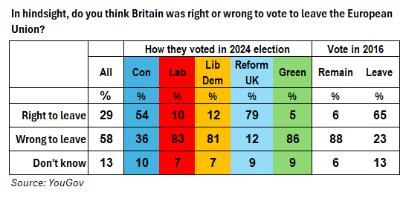
N.B. The above exclude C.8m voters who have reached voting age since the referendum.
Perhaps the most interesting stat is the 36% of Tory voters who think leaving was wrong, which shows that whilst centre-right Tory MPs are history, they still have middle-ground voters.
The latest byelection in Makerfield, a constituency that voted 65-35% for Brexit. How many regret that is debatable. What we do know is that Reform won nearly 50% of votes in this month’s local elections in the eight wards overlapping Makerfield. Therefore, it is unlikely that BrexIN will feature much in the campaign.
Of course, all of this is theoretical. Whilst the electorate clearly regret the decision, there is little sign of the government reversing, and even less that the EU would welcome us back.
‘there is little sign of the government reversing, and even less that the EU would welcome us back’
Whilst the government has made it clear that it wants even closer relations, the current negotiations which cover areas ranging from agriculture to participation in the EU’s electricity market, have stalled over the EU’s insistence that the youth experience deal it sees as key to the whole package allows EU students to pay domestic fees to attend UK universities.
Moreover, the EU will not allow us to select bits of the single market that suit our ends. Furthermore, we are constrained by the governments manifesto pledge that we will not rejoin the single market or customs union, or accept freedom of movement.
Research suggests that rejoining the customs union might not compensate for the economic impact of Brexit, and could leave us tied to EU trade deals over which we have no say. Equally, rejoining the single market means would allow the EU to set the rules for the UK economy whilst we might be consulted we would have no vote.
This, in-effect would be the “Norwegian Option”, which works for them as they have removed the decision-making from politicians placing it under the control of unelected experts, independent agencies, with rigid legal frameworks. In effect making it about objective “efficiency” rather than ideology
The hopes and assumptions that drove Brexit might be ruins, but Nigel Farage, the architect of Brexit remains unusually silent on the subject, with the odd murmur of “it wasn’t done properly”, or “traitor” to remainers.
‘The hopes and assumptions that drove Brexit might be ruins, but Nigel Farage, the architect of Brexit remains unusually silent on the subject’
Farage has moved on, immigrants have replaced the EU as his scapegoat of choice, even though data from the ONS shows net migration at its lowest level since 2021.
Net migration fell by C.50% to 171,000 last year, down 48% year on year from 331,000 in 2024, extending the decline from a record peak of 944,000 in 2023.
We are told that immigration is the reason the government has so little money to spend.
Government spending is based on “priorities”, how and where they decide to spend our funds. Within this there are for infrastructure projects,
Typically, they are very expensive, and we aren’t good at them. The ill-fated HS2 project proves that.
HS2 was first approved by the coalition government in January 2012 with a £32.7bn budget to build a Y-shaped high-speed track as far as Manchester and Leeds, and scheduled to be operable by 2026. That figure excluded rolling stock, which is now included in the revised budget.
Today, the cost is £102.7bn and trains will not start running between London and Birmingham until 2039; £70bn over budget and 13-years late.
‘£70bn over budget and 13-years late’
The transport secretary, Heidi Alexander, said two-thirds of the budget increase was due to works being missed from the scope of the original plans, underestimates and inefficient delivery.
She added: “I can confirm that the previous government spent most of HS2’s budget without laying a single mile of track.”
Staying with public spending, this week, the IMF supported Chancellor Reeves fiscal redlines, whilst reminding her to focus on “controlling the rising welfare bill, as well as delivering further efficiency measures in public services, while protecting the most vulnerable”.
Another legacy of the coalition government was 16-yrs of austerity, meaning that today there is little left to cut from benefits for disability or unemployment.
Despite this austerity, the coalition was decided to offer pensioners what is referred to as the triple-lock increase to their pensions.
The OBR estimates the annual cost of this will be £15.5bn by 2030.
They further found that the cost of the state pension has risen over the past 80-yrs from C.2% of GDP to a current 5%, equating to £138bn.
Overall, aside from the state pension, pensioner benefits total C.£31bn.
‘Why then, do we never discontinue the triple lock? Votes‘
Overall, pensioner benefits are currently C. £170bn p.a., a figure greater than the housing benefit, disability benefit and unemployment or low-income benefits bills combined.
Why then, do we never discontinue the triple lock? Votes
Pensioners vote, turn-out in high numbers, and are well represented in the media.
The average age of a Daily Mail reader is typically between 56 and 58 years old, however for the print edition, nearly 50% are 65+.
The typical reader of the Daily Express is 69 years old.
The overall average age of The Daily Telegraph reader is C.46 years old, however, the print readership has C.54% aged 65+.
The young, if they are eligible to vote, tend not to. For Gen Z (under-25), Instagram is their social-first news source, used widely for daily updates and cultural news.
So, where does the UK go next?
‘So, where does the UK go next?’
It has taken 50-yrs to create the mess we are in, and it will take many years to correct.
A loose translation of a old Chines proverb is “A journey of a thousand miles begins with a single step.”
Clearly, if we are to halt our decline change is required.
Right-wing thinking has been dominated these 50-yrs, even the labor years have been based on this doctrine.
Reform and the Tories represent continuity, in the formers case with added racism and nastiness.
When Covid hit we returned to big government and their bail-out funds.
Perhaps, now it is time we realised that we can’t pick and chose when we need government and accept that government is required if we want anything approaching equality and progress.
“But I can’t help it
I’m a romantic fool”
@coldwarsteve
 Philip Gilbert is a city-based corporate financier, and former investment banker.
Philip is a great believer in meritocracy, and in the belief that if you want something enough you can make it happen. These beliefs were formed in his formative years, of the late 1970s and 80s
Click on the link to see all Brexit Bulletins:

The post The Times They Are A-Changin’: Where Next for the UK? appeared first on USNewsRank.