
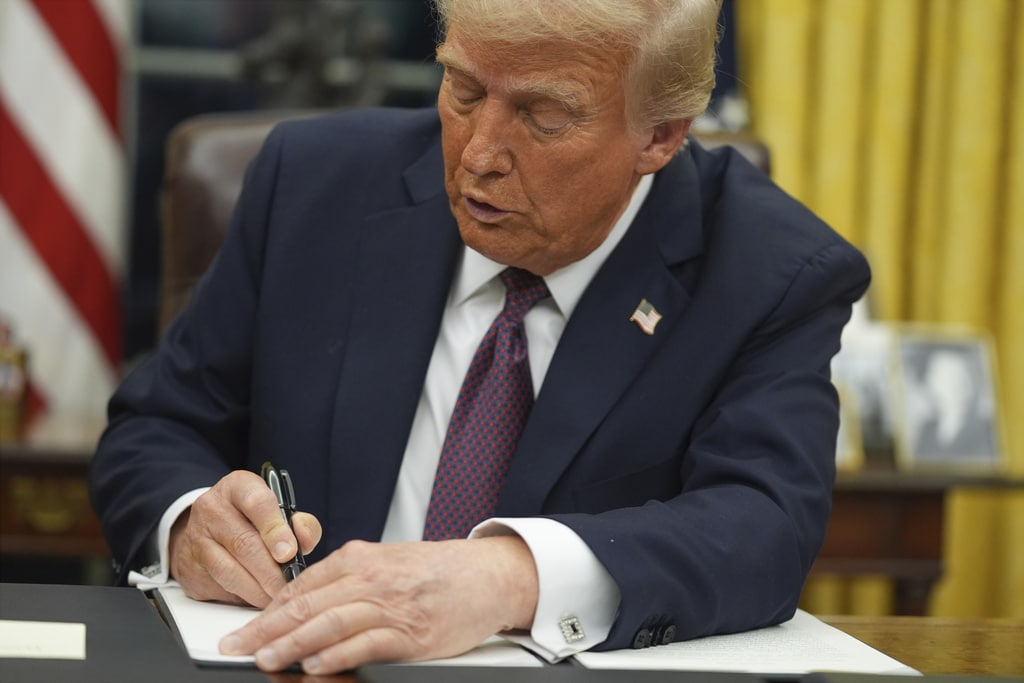
President Trump signed an executive order ending “birthright citizenship” based on what he called “a proper interpretation of the law.” This sparked a series of lawsuits by pro-immigrant organizations. On Thursday, January 23, a judge temporarily blocked the order.
Washington — As part of his plan to tighten immigration laws, President Donald Trump fulfilled his promise to sign, on his first day in office, an executive order that revokes automatic citizenship for children of immigrants who do not have permanent legal status in the United States. The executive order prohibits the recognition as U.S. citizens of children of foreign parents who are not subject to the jurisdiction of the United States pursuant to the Fourteenth Amendment.
The Trump administration says the executive order is based on a “correct interpretation of the 14th Amendment.”
Changes in the 14th Amendment
A bit of history
The 14th Amendment did not always guarantee birthright citizenship to all those born in the United States. In fact, Congress did not authorize citizenship to all Native Americans born in the United States until 1924.
The 14th Amendment was ratified in 1868, overturning the Dred Scott decision that denied black Americans the rights and protections of U.S. citizenship. In 1898, the U.S. Supreme Court confirmed in United States v. Wong Kim Ark that children born in the United States to immigrant parents were entitled to U.S. citizenship, and the principle has remained unchanged as a constitutional cornerstone for more than a century.
According to the Heritage Foundation, an institution that promotes conservative policies in Washington, the universal right to birthright citizenship is “misinterpreted.”
According to the Heritage Foundation, children born in the U.S. to undocumented foreign parents or temporary visitors should not be considered U.S. citizens because the parents “are not subject to the jurisdiction of the United States,” an explicit requirement in the amendment.
What does the law say about birthright citizenship?
Birthright citizenship is derived from the 14th Amendment to the U.S. Constitution, which states that “all persons born or naturalized in the United States, and subject to the jurisdiction thereof, are citizens of the United States and of the State wherein they reside.”
“This is a constitutional right and the president cannot revoke it with a signature. This is important because the right still exists today, no matter what you heard from President Trump or because of the executive order,” Maya Wiley, CEO of the Leadership Conference on Civil and Human Rights, explained at a joint conference.
“The important thing to remember is that this is a civil right that started with a right that was given to freed slaves and you have to understand that it is a fundamental principle,” Wiley added.
According to experts, for this executive order to come into effect, the 14th Amendment would have to be changed, which represents a complex process because it would involve a change to the Constitution.
“The 14th Amendment guarantees birthright citizenship and to end that, a constitutional amendment will be required. This executive order is going to be the subject of litigation so it will take a long time for it to reach the Supreme Court and make a decision,” said Muzaffar Chishti, director of the Migration Policy Institute.
Since when does the executive order apply and who does it affect?
According to the decree, the measure is not retroactive and will apply to all children of undocumented parents born after February 19, 2025, unless one of them is a U.S. citizen or permanent resident of the United States.
“This also affects people who are here on a nonimmigrant visa, such as a temporary immigration status. For example, if they are on work visas such as H1B or L1, that is, those people who are here legally because they have come to work for a company, if they have children, these would no longer be US citizens if they were born in the US,” Freg Chen, director of Government Relations for the American Immigration Lawyers Association, responded to the Voice of America at a virtual conference organized by America’s Voice.
It would also affect those immigrants who have Temporary Protected Status (TPS) or are waiting for an asylum application.
The order also states that passports and Social Security numbers will not be issued to children born in the U.S. after February 19 who do not show proof of legal status for at least one of their parents.
This situation will trigger a “logistical nightmare” for agencies because, according to experts, the new requirements for requesting this type of document will apply to all people in the US.
On the other hand, the Trump campaign stated in a written statement that this executive order is a way to “fulfill the president’s promise” to end what they call “birth tourism.”
Judge temporarily blocks executive order
Following the signing of the decree, lawsuits against the US government were quickly filed, which considered the executive order “unconstitutional.”
Hours after this article was published, Judge John C. Coughenour temporarily blocked the executive order that sought to end automatic birthright citizenship regardless of the immigration status of the parents.
This is just one of five lawsuits filed by 22 states and several civil rights and immigrant rights groups across the country.
The American Civil Liberties Union chapters in New Hampshire, Maine and Massachusetts, along with other immigrant rights advocates, also filed a lawsuit in federal court in New Hampshire to stop the executive order.
The District of Columbia and the city of San Francisco joined in this suit.
“The president argues that the amendment is for people who are under the jurisdiction of the United States and that is something that has already been clarified and confirmed by the Supreme Court since 1898. Because it is a right that is in the Constitution, we argue that this executive order is illegal and in fact, as soon as it was signed, we filed the lawsuit requesting that it be immediately suspended,” Alba Villa, development director of LULAC, one of the plaintiff organizations, told the Voice of America .
Similarly, on Wednesday, five pregnant mothers, the organization CASA, the Asylum Seeker Advocacy Project (ASAP), filed a lawsuit in a Maryland state court in response to the executive order seeking to end birthright citizenship.
The White House, for its part, said it is ready to take on the states in court, calling the lawsuits “nothing more than an extension of leftist resistance.”
As of press time, the U.S. government had not responded to Judge John C. Coughenour’s temporary ruling.