

Krista Marie Yu | Photo from Mike Palma/East West Players
LOS ANGELES – “Flower Drum Song,” Rodgers and Hammerstein’s golden age musical with an updated book by David Henry Hwang and presented by East West Players (EWP), blooms and sings.
Freshened up by David for the grand finale of EWP’s 60th-anniversary season, “Flower Drum Song,” while still set in the 1960s, is a vibrant, joyful show, even as it tackles themes of immigration, assimilation and Asian American identity.
A celebration of Asian identity and culture

Playwright David Henry Hwang, who revised ‘Flower Drum Song,’ at the opening night | Photo by Ruben V. Nepales
David told me in our previous email interview, before the show opened, “I looked over my 2001 revival version and felt, similar to the original 1958 script, that my own version had grown a little rusty and outdated in the intervening quarter-century. I believed I could do better.”
You may like: Revised ‘Flower Drum Song’ musical echoes challenges faced by immigrants
The Tony Award winner and three-time Pulitzer finalist also promised, “I am basically retaining the premise and structure of my 2001 version, while also striving for greater cultural authenticity and revising some of the jokes and dialogue that felt I had been pandering to a Broadway audience, or which just haven’t aged well!”
And he did all of that. With David’s tweaks, there are no more cringey characters that perpetuate Asian stereotypes. Instead, the show overall is a celebration of Asian identity and culture without being heavy-handed.
‘A Hundred Million Miracles’
In the recent opening night at the Aratani Theatre in Los Angeles’ Little Tokyo, the musical, directed by Lily Tung Crystal, enchanted and amused. The cast delivered in spades.

Brian Shimasaki Liebson, Marc Oka, Scott Keiji Takeda and Joven Calloway | Photo from Mike Palma/East West Players
Hearing the opening song, “A Hundred Million Miracles,” instantly reminded me of Lea Salonga trilling that number in her exquisite soprano voice in the 2001 Mark Taper Forum revival that went on to Broadway. But Grace Yoo, as Mei Li in the EWP production, immediately commanded the stage as she performed the same song and in her numbers throughout the show.
David was true to his word: “We are much more specific now about why Mei-Li flees China to enter the US as a refugee, with a backstory which reflects the actual history of how the Cultural Revolution began to target theater artists.” Indeed, this 2026 update emphasizes more than the 2001 revival that Mei Li is no longer a Chinese mail-order bride as she was in the original Broadway musical.
Defying the leading man stereotype, EWP cast Scott Keiji Takeda as Ta. With his tenor voice, he mesmerizes. Cooper Lee Bennett, as Chao, Mei Li’s fellow refugee who is also smitten with her, is equally compelling.
Cast
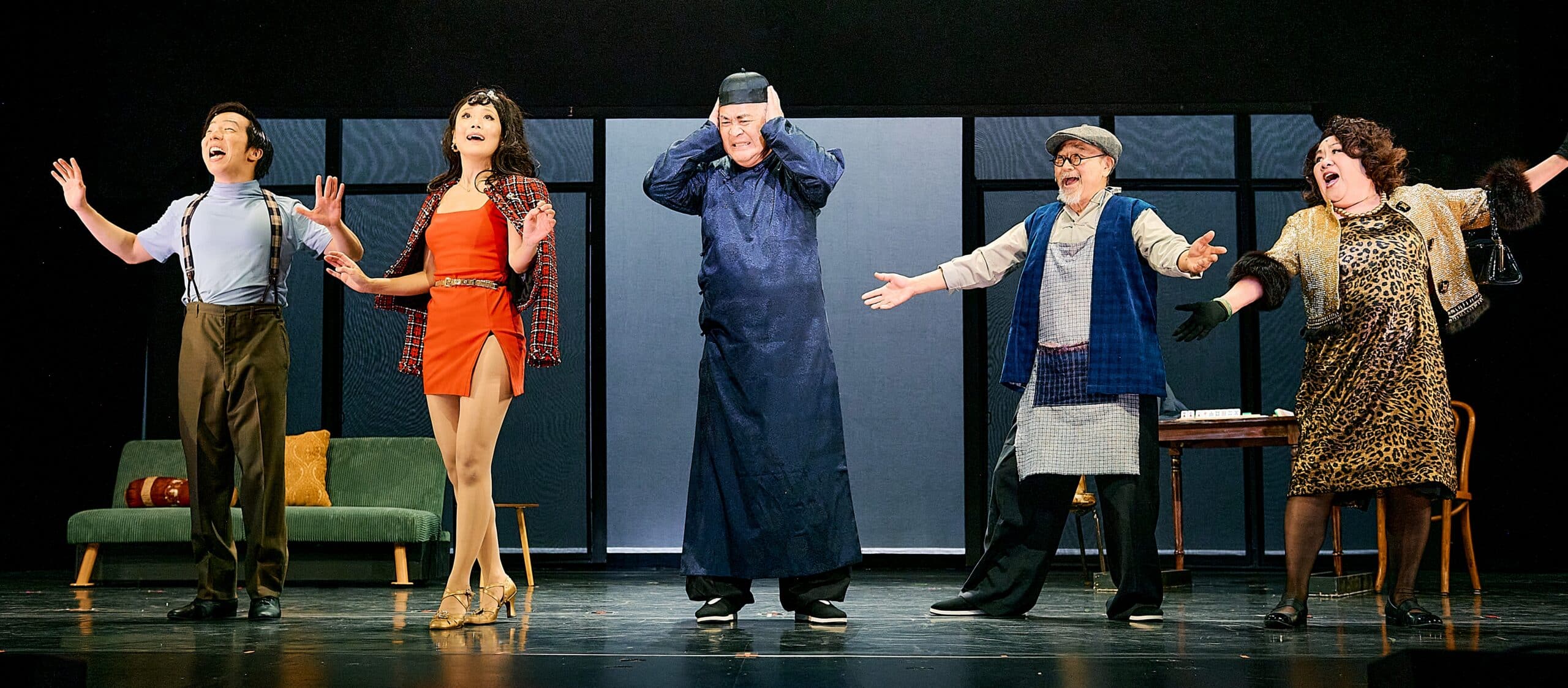
Kenton Chen, Krista Marie Yu, Marc Oka, Gedde Watanabe and Emily Kuroda | Photo from Mike Palma/East West Players
The veteran actors, proving the value of many years of experience on the stage, steal the show whenever they appear. Marc Oka (Wang), Emily Kuroda (Madame Liang, now a shrewd businesswoman instead of a chatty aunt), and Gedde Watanabe (Chin) are delightful and add enormously to the show’s humor. Marc and Emily win over the audience with their duet, “Don’t Marry Me.”
Marc Oka | Photo from Mike Palma/East West Players
One of David’s significant revisions is his overhaul of the Harvard character, from a queer stereotype into an LGBTQIA+ character, given a storyline and fully fleshed out by Kenton Chen. Not only that – the delightful Kenton has a celebratory number in the finale that reflects how jubilant this show is. A star is born in Kenton in this production.
Krista Marie Yu, who plays Linda Low, the character memorably played by Nancy Kwan in the 1961 movie adaptation, rounds out the principal cast.
The talented ensemble and understudy cast includes: Joven Calloway, Ethan Yaheen-Moy Chan, IJay Espinoza, Sierra Goria, Sally Hong, Tony Jin, Esther Lee, Brian Shimasaki Liebson, Emma Park, Gemma Pedersen, Hillary Tang, Ai Toyoshima, Haoyi Wen, and Paul Wong.
Choreography
Janelle Dote Portman’s choreography greatly enhances the show’s entertaining appeal. As David said in our interview, “I have to say that I am particularly gratified by how ‘Fan Tan Fannie,’ which was never regarded as a great song, has been put on steroids and transformed into a sexy, exciting number, in both the 2001 and our present versions.”
“Fan Tan Fannie” was already a show-stopping dance number in the 2001 revival, but in this year’s version, it sizzles.
Filipino American Marc Macalintal, celebrating his 17th show as EWP’s music director, masterfully conducted the band through the show’s songs, which remains intact from the 2001 staging, including the beautiful “Love, Look Away,” “I Enjoy Being a Girl” (now seen as an empowering anthem celebrating femininity, as sung with pizzazz by Krista Marie), “I Am Going to Like It Here,” and the lively “Chop Suey.”
The production is a visual delight, thanks to the creative team, which includes Chen-Wei Liao (scenic designer) and Ruoxuan Li (costume designer).
Fabulous finale

Kenton Chen (holding mic), who plays Harvard, performs a celebratory number at curtain call | Photo by Ruben V. Nepales
Fittingly, the finale is a fabulous, cheerful celebration of Asian roots and identity. In a nice touch, each of the ensemble proudly declared where they were born – two actors said they were originally from the Philippines.
Many actors and talents were in the audience who rose and gave the show and cast an exultant standing ovation. Joan Almedilla, fresh from the hit “Here Lies Love,” proudly said to me that Grace Yoo played her daughter Sophie in EWP’s “Mamma Mia!”

Bryan Geli, Reggie Lee and Joan Almedilla at the opening night | Photo by Ruben V. Nepales
Based on the opening night, David’s fervent wish for “Flower Drum Song” should come true: “I hope audiences fully embrace a classic American ‘golden age’ musical and feel that it has been remade with love and authenticity. I hope they laugh and have fun and see a little of themselves onstage.”
Do watch this “Flower Drum Song” – it delivers that and more.
You may like: ‘A boost in Fil-Am representation in LA theater stirs hope for more‘
As for me, I hope that “Flower Drum Song,” “Here Lies Love,” “Kim’s Convenience,” “Dragon Mama” and “Luca & Uri,” all stage productions that tap Asian talents in the first half of 2026, will continue AAPI representation year-round, especially in the major theater companies.
“Flower Drum Song” is playing at the Aratani Theatre, located at the Japanese American Cultural and Community Center (244 S. San Pedro St. in Little Tokyo) until May 31. Performances take place on Fridays, Saturdays and Sundays, with additional select weekday shows and matinees on Saturdays and Sundays.
Ruben V. Nepales is an LA-based journalist whose honors include nine first prizes from the National Arts & Entertainment Journalism Awards and the Los Angeles Press Club’s Southern California Journalism Awards. He authored “Through a Writer’s Lens,” which won first prize in nonfiction at the 2020-2021 National Arts & Entertainment Journalism Awards. In 2004, he became the first Filipino voter of the Golden Globe Awards, He is a member of the Golden Globe Foundation, one of Hollywood’s biggest philanthropic organizations.
The post ‘Flower Drum Song’ blooms again with joy and relevance appeared first on USNewsRank.